
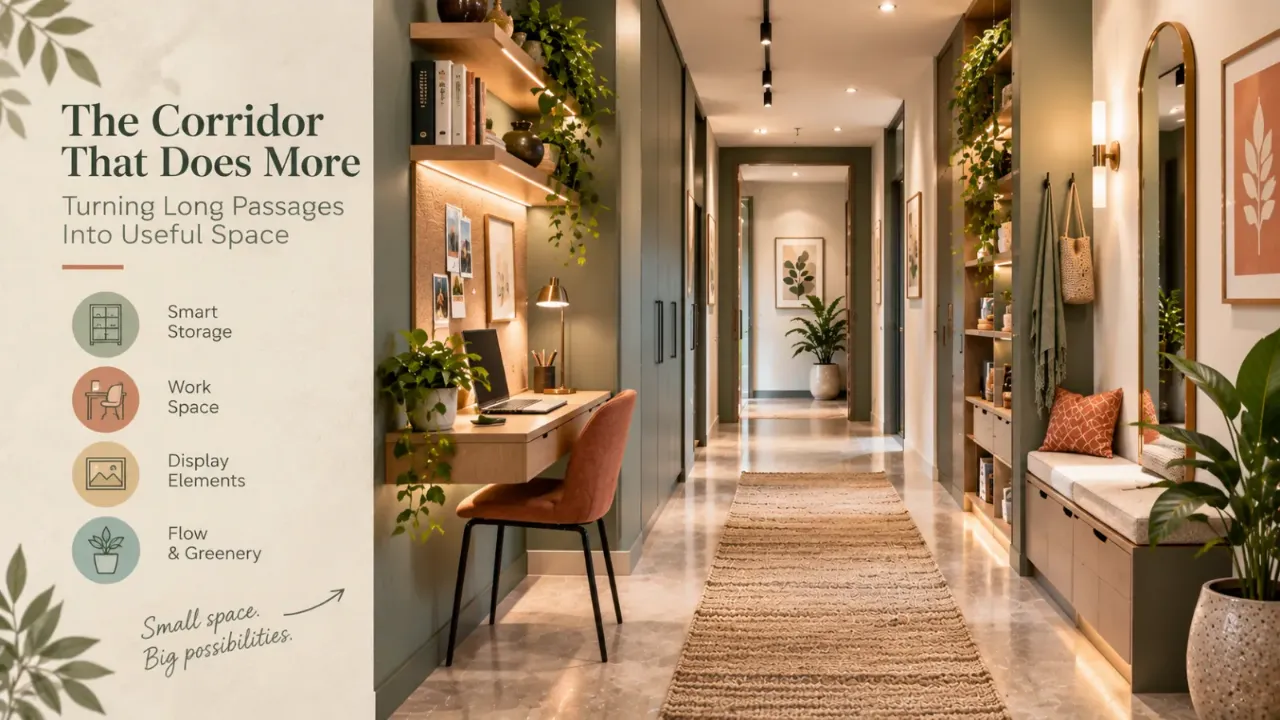
The Corridor That Does More: Turning Long Passages Into Useful Space
A long corridor is one of the easiest parts of a home to ignore. It connects one room to another, people walk through it, doors open from it, and once the furniture is placed elsewhere, there is often little left to do.
But a corridor can do more. It can provide storage, display books and artwork, become a small work or study zone, hold everyday items near bedrooms, and create a visual transition between different parts of the home.
It is to give the edges a purpose while protecting the path through the middle.
First, Protect the Main Walking Path
Before thinking about storage, decor, seating, or display, understand how people actually move through the space.
Where do they enter? Where do they turn? Which doors open into the corridor? Which rooms depend on the corridor for access? Are there moments when several people use it at once?
Think of the corridor as having two zones: the movement zone and the edge zones.
The movement zone stays clear. The edges do the work.
Measure the Corridor Before Adding Anything
A long corridor can feel spacious because of its length, but the width is what determines how much can safely and comfortably be added.
Measure the clear width rather than simply measuring wall to wall.
- Door swings
- Cabinet depth
- Handle projection
- Wall panelling
- Seating
- Electrical points
- Switchboards
- Other fixed elements
The final test is always the clear path after everything is installed.
Give the Corridor One or Two Real Jobs
The biggest mistake is trying to make the corridor useful by giving it ten different functions.
Linen storage, family photo gallery, books, or quiet display.
Shoe storage, mirror, bags, keys, umbrellas, or other everyday items.
Bookshelf, artwork, display storage, or a visual transition.
A compact work, study, or reading zone where the geometry genuinely allows it.
Built-In Storage Can Turn a Corridor Into Useful Square Footage
If the corridor is wide enough, one of the most effective uses is storage.
A built-in unit can hold linen, cleaning supplies, household accessories, books, seasonal items, bags, shoes, children's belongings, extra crockery, or documents.
In a corridor, shallow storage is often more valuable than maximum-depth cabinetry because the goal is to gain storage without reducing circulation too much.
Use Storage According to the Nearby Rooms
Do not store random things simply because there is an empty cabinet. Look at what the adjacent rooms need.
A corridor outside bedrooms can hold linen. A corridor near the kitchen can hold serving pieces or pantry overflow. A passage near children's rooms can hold toys, books, or school supplies. A corridor close to the entrance can hold shoes, bags, keys, umbrellas, or everyday accessories.
Linen Storage Is a Natural Corridor Function
Long corridors near bedrooms can reduce pressure on bedroom wardrobes.
A shallow built-in cabinet can store bedsheets, towels, blankets, extra pillow covers, and seasonal bedding.
Create a Gallery Wall, But Give It Structure
A long corridor naturally creates a strong linear wall. That makes it an excellent place for photographs, artwork, illustrations, or a family gallery.
Use a consistent frame finish, repeated spacing, one artwork size, a structured grid, a mix of sizes within one visual order, or a continuous picture ledge.
The goal is to give the wall a visual rhythm.
Turn the Corridor Into a Family Timeline
A corridor near bedrooms or family spaces can become an especially personal part of the home.
Wedding photographs, first-home memories, children, travels, milestones, or other meaningful moments can turn the corridor into part of the family's story.
Add a Narrow Bookshelf
A corridor can sometimes accommodate a slim bookshelf without feeling crowded.
A shallow bookshelf can turn an otherwise blank wall into useful storage.
Use a Picture Ledge Instead of Deep Shelving
If full shelving feels too bulky, a narrow picture ledge can provide a lighter solution for artwork, children's drawings, family photographs, or small decorative objects.
Add a Small Work Niche Only Where the Geometry Allows It
Long corridors sometimes contain a wider pocket near a bedroom or living area. That can become an opportunity for a compact desk.
A simple setup might include a wall-mounted work surface, one chair, a few shelves, a task light, and concealed cable management.
Do not force a desk into a narrow passage simply because there is an empty wall.
A Corridor Can Become a Small Reading Spot
A wider section of corridor may accommodate a single armchair or built-in bench.
This can create a quiet reading corner without demanding a complete room.
But the seating should sit in a widened pocket, not directly inside the walking path.
Make the Corridor a Transition Zone
Sometimes the corridor's best function is connecting two different parts of the home.
Use a slightly different wall colour, lighting mood, artwork style, ceiling treatment, flooring treatment, or material detail to create a deliberate transition.
Lighting Matters More Because Corridors Are Long
Long corridors often have one lighting problem: they are either too dark or evenly over-lit.
Instead, think in layers.
Provides comfortable overall visibility.
Can wash a wall or illuminate artwork.
Highlights niches, shelves, or selected objects.
Provides a softer route through the home after dark.
Use Light to Break the Length
A long corridor can feel even longer when everything runs continuously.
Lighting can introduce visual pauses: a brighter artwork zone, a softer wall, another highlighted niche, then a quieter transition.
Mirrors Can Help—But Use Them Strategically
A mirror can make a narrow corridor feel visually wider, bounce daylight, add depth, or become useful before leaving a bedroom area.
Think about what it will actually reflect. A mirror should solve a problem rather than simply occupy an empty wall.
Break the Wall With Niches
Recessed niches can create useful visual breaks for art, sculptures, photographs, small plants, or decorative objects.
They should be planned carefully during construction or renovation rather than casually created in a wall whose construction is not understood.
Use Wall-Mounted Elements Where Floor Space Is Precious
- Floating shelves
- Wall-mounted drawers
- Picture ledges
- Floating cabinets
- Wall hooks
- Hanging planters
- Mounted lighting
This keeps the floor visually cleaner and protects movement.
Hooks Can Be Surprisingly Useful
A defined hook zone can handle bags, hats, light jackets, school bags, or reusable shopping bags.
Use hooks selectively rather than turning the corridor into an exposed storage wall.
Conceal the Things That Create Visual Noise
Not every useful item needs to be visible.
Closed cabinetry can hide household objects that would otherwise make a long corridor feel messy, while open shelving can be reserved for things you actually want to display.
Do Not Make the Corridor a Second Living Room
A long corridor does not mean every section needs furniture.
A console, chair, side table, plant, lamp, sculpture, bench and cabinet can quickly turn circulation into an obstacle course.
Use the Ceiling Carefully
The ceiling can help define the corridor without adding anything to the floor.
- Linear lighting
- Subtle ceiling detailing
- Repeated lighting intervals
- A change in ceiling finish
- Visual transition near important room entrances
Colour Can Make a Long Corridor Feel Shorter
One continuous wall colour can emphasise length. If the corridor feels excessively long, create visual breaks with artwork groups, a feature wall, contrasting built-in cabinetry, a coloured niche, or a material change.
Make the End of the Corridor Matter
The wall at the end of a long corridor has unusual visual power.
Use a feature artwork, textured wall, large photograph, decorative panel, window view, sculptural element, or mirror where appropriate.
You do not need to overdecorate the entire corridor if the end point provides a strong visual destination.
Use the Corridor for Hidden Storage
A flush cabinet can disappear into the wall visually. A door can match the wall finish. A storage unit can use the same colour as surrounding panels.
The storage is there. The visual clutter is not.
Think About Doors Before Installing Cabinets
A corridor may have several room doors opening into it. Each door takes up movement space.
Before finalising storage, open every nearby door and check the actual movement envelope. The corridor should work with doors open as well as closed.
Keep Electrical Points Accessible
A corridor may contain switches, sockets, internet points, sensors, or other services.
Do not cover them with custom cabinetry simply because the wall looks empty. Design around existing services rather than burying them.
Do Not Forget Cleaning
Long corridors collect dust simply because they are used frequently.
If you add cabinets, niches, shelves, and decorative objects, you also create more surfaces to clean.
Choose practical finishes, avoid unnecessary ledges, keep floor storage limited, and give objects a clear home.
Use Flooring to Strengthen the Design
A long corridor creates a strong visual line. You can either emphasise it or break it.
Large-format flooring can create a calmer appearance. A runner can make the space feel softer and visually define the path. A change in flooring can mark a transition.
The Corridor Can Become a Memory Wall
If you do not need more storage, the corridor can become an emotional part of the home through travel photographs, children's artwork, family portraits, collected objects, or small framed memories.
The key is curation. Choose a theme or sequence rather than putting every photograph on the wall.
A Long Corridor Can Be a Design Opportunity
Stop asking: “How do I fill this empty corridor?”
Ask: “What does the home currently need that this corridor can provide?”
Maybe the answer is storage. Maybe it is display. Maybe it is a quiet work zone. Maybe it is simply better lighting and a more deliberate transition between rooms.
A Practical Long-Corridor Checklist
Protect a clear, comfortable walking path before adding furniture or storage.
Use shallow built-ins for linen, shoes, books, household supplies, or other nearby needs.
Use artwork, photographs, shelves, ledges, or niches to give long walls a visual rhythm.
Layer general, wall, accent, and night lighting instead of relying on one continuous row of fixtures.
Use only genuinely wider pockets for a compact desk, study area, or household workspace.
Add a bench or chair only where a widened area protects the main passage.
Use the end of the corridor for a strong artwork, texture, view, or other focal element.
Choose practical finishes and avoid unnecessary shelves, ledges, and hard-to-clean corners.
What Not to Do With a Long Corridor
- Deep cabinets that make the passage feel tight
- Furniture placed directly in the main walking path
- Too many decorative objects
- Randomly spaced artwork
- Oversized consoles
- Freestanding storage that could be wall-mounted
- Seating without enough surrounding clearance
- Storage that blocks doors or switches
- Dark corners with no useful lighting
- Decorative niches created without checking the wall structure
The Best Corridor Has a Visual Rhythm
Think about what someone sees while walking through the space.
Maybe: Artwork → storage → artwork → open wall → seating niche → feature wall.
Or: Mirror → concealed storage → family photographs → open section → artwork.
The elements do not have to repeat exactly. But there should be a rhythm.
Before You Add Storage, Do a Walking Test
Use masking tape to mark the proposed cabinet depth on the floor. Then walk through the corridor. Open nearby doors. Carry a laundry basket. Carry shopping bags. Walk in both directions. Imagine two people passing. Try opening a proposed drawer.
A corridor has to work in motion.
The Most Useful Corridor Is Not the Most Decorated One
A corridor becomes successful when the space solves a real problem without creating a new one.
A little storage can remove clutter from bedrooms. A gallery can turn a blank wall into something personal. A small work niche can make use of an awkward pocket. Better lighting can make the whole home feel more considered.
Bring Your Actual Corridor Into the Design
Every long corridor has different widths, door positions, lighting conditions, wall lengths, and storage opportunities.
Photograph yours from both ends and from the adjacent rooms. Then look for the areas that can actually support a function without compromising movement.
Visualise Your Corridor
With Walls to Wonder's AI Design My Room tool, you can upload a room photo and explore different interior directions around your existing space.
When you are ready to develop the corridor as part of the wider home, you can also explore professionals through Walls to Wonder's designer platform.
Final Thought
A long corridor does not have to be dead space.
But it also does not need to become a storage tunnel filled with furniture.
The smartest approach is simpler: protect the path, give the edges a purpose, create visual rhythm, and use the length deliberately.
A corridor can quietly solve storage problems, display the things that matter to you, improve lighting, and make the transition between rooms feel intentional.
The best long corridor is not the one that looks busiest. It is the one that makes the rest of the home work better.
Frequently Asked Questions
1. How can I make a long corridor useful?
Start by identifying one or two real needs in the home. Depending on its width and location, a corridor can provide shallow storage, linen cabinets, bookshelves, display space, a compact work niche, seating, or a better transition between rooms.
2. What can I put in a long narrow corridor?
Wall-mounted or shallow elements are usually safer choices than deep furniture. Consider artwork, picture ledges, floating shelves, slim storage, mirrors, hooks, or integrated lighting, provided the clear walking path remains comfortable.
3. Can I put a cabinet in a corridor?
Yes, when the corridor has sufficient width and the cabinet does not interfere with circulation or nearby doors. Measure the actual clear passage after accounting for the cabinet, handles, doors, drawers, and other fixed elements.
4. Is a gallery wall a good idea for a long corridor?
Yes. A long wall can provide an excellent setting for artwork or family photographs, especially when the display has a consistent visual system rather than random spacing.
5. Can a long corridor become a study area?
Only if there is a genuinely wider pocket with enough room for the desk, chair, movement, and comfortable use. A normal circulation path should not be turned into a workspace simply because one wall is empty.
6. How do I make a long corridor look less like a tunnel?
Create visual destinations rather than one uninterrupted line. Artwork groups, lighting, a feature at the far end, selected material changes, mirrors, or carefully positioned storage can break the visual length.
7. Should I decorate every wall of a long corridor?
No. Leaving some walls quiet can make the corridor feel more spacious and balanced. A few strong interventions are usually more effective than filling every available surface.
8. What is the biggest mistake when designing a long corridor?
Adding so much furniture or storage that the corridor stops functioning as a comfortable circulation route. The passage should remain the priority, with every other function fitted around it.
Turn this idea into a plan for your home
Visualise your space, understand the likely budget, or find a professional who can bring the idea to life.