
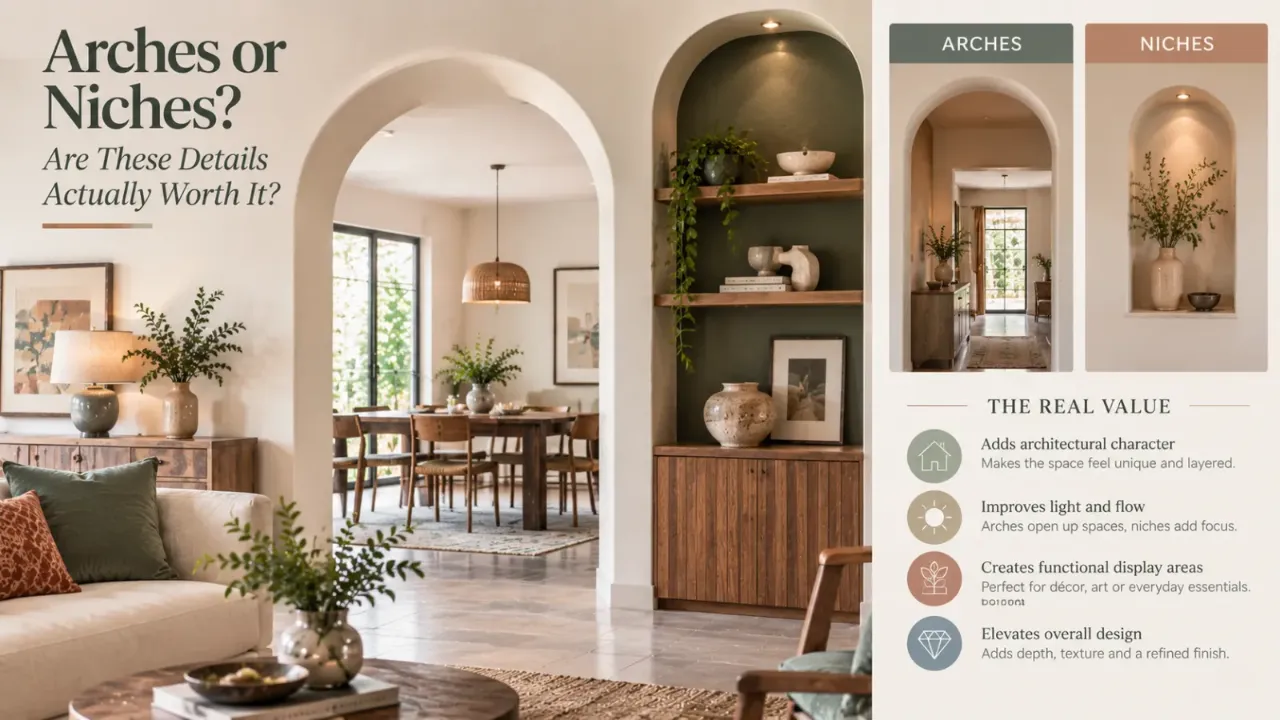
Arches or Niches? Are These Details Actually Worth It?
There is a reason arches and niches keep appearing in interior-design inspiration. An arched doorway can instantly make a passage feel softer. A wall niche can turn a plain surface into something architectural. But unlike a cushion or paint colour, an arch or built-in niche can involve construction changes.
That means the real question is not simply, “Does it look good?” It is: “What does it improve?”
What an Arch Actually Adds
An arch changes the geometry of a space. A conventional rectangular doorway has a straightforward visual language: vertical sides and a horizontal top. An arch replaces that hard upper line with a curve.
The effect can feel softer, more traditional, more Mediterranean, more contemporary or more handcrafted depending on the shape, material and surrounding finishes.
But the arch itself is not a style. It is a shape. Its personality comes from what you put around it.
An Arch Works Best When It Connects Two Spaces
Arches are particularly useful when two adjoining areas already need some visual relationship: living room to dining area, dining area to passage, entry to living room or bedroom to dressing area.
Instead of making the doorway feel like a hard interruption, the curve can create a gentler visual transition.
Don't Add an Arch Where a Door Needs to Be
An open archway and an arched door are not the same design problem. If the opening needs to close for privacy, sound, ventilation or separation, you need to think about the actual door system first.
In bedrooms, bathrooms, studies or kitchens, practicality may matter more than appearance. A beautiful opening that does not serve the room's functional needs is still a poor design decision.
The Width and Proportion Matter More Than the Trend
A narrow opening with a very dramatic curve can feel theatrical. A wide opening with a shallow curve can feel much calmer.
A small room may need a restrained arch. A large room may be able to handle something more substantial.
This is why copying an arch from a large villa into a compact apartment often produces a strange result. The shape may be identical. The proportions are not.
Arches Can Soften Straight-Line Interiors
Modern homes often contain a lot of rectangles: rectangular windows, cabinets, tiles, furniture and doorways. Adding one well-placed curve can interrupt that repetition.
You do not necessarily need a traditional home to use arches. A restrained curve against a very clean interior can become one of the room's strongest architectural details.
But One Arch Is Often Enough
Once you see how effective an arch can be, the temptation is to repeat it everywhere.
Now Consider the Niche
Unlike an archway, a niche is usually about creating depth within a wall. It can be decorative, hold objects, frame artwork, accommodate small storage or become a place for lighting and display.
Because it is recessed rather than projecting into the room, a well-planned niche can add function without taking up conventional floor area.
A Niche Should Have a Job
Before building one, finish this sentence:
Display a sculpture.
Hold toiletries.
Store books.
Create a bedside ledge.
Frame artwork.
Provide a place for keys.
House a small collection.
If you cannot finish the sentence, the niche may simply be decoration looking for a reason to exist.
Bathroom Niches Can Be Highly Practical
A shower niche can be one of the more useful applications because it can keep frequently used products within reach without adding another projecting shelf.
But this is where construction quality matters more than the photograph. Water exposure, slope, waterproofing, dimensions and finishing details need proper consideration.
The niche should be planned as part of the bathroom construction, not treated like a last-minute decorative cut-out.
Kitchen Niches Need Even More Planning
A niche in a kitchen can be useful for display, appliances, jars or frequently used objects.
But kitchens are high-activity spaces. Steam, grease, dust, cleaning and heat can all affect how practical an open recess is.
Before building one, ask whether an open recess is actually better than closed storage. Sometimes it is. Sometimes a cabinet door is the smarter design.
Bedroom Niches Can Replace Small Furniture
A recessed niche beside the bed can provide a place for books, a phone, small objects or decorative lighting.
This can be especially useful where the room is too tight for large bedside tables.
Entryway Niches Can Create a Small Drop Zone
A recessed wall niche near the entrance can sometimes become a compact place for keys, small décor or a carefully edited display.
Add subtle lighting and it can also help define the entrance visually. But the niche should not become a random pocket for household clutter.
Decorative Niches Work Best When They Are Edited
A niche does not need to be full. In fact, it often looks better with fewer objects.
- One sculpture
- A small artwork
- Three carefully chosen books
- A vase
- A plant
- A collected object
The negative space around the objects is part of the design.
Lighting Can Make or Break a Niche
A niche with no lighting can still work. A poorly placed light can make it much worse.
A concealed strip can wash the interior surface softly. A focused light can turn a single object into a focal point.
But excessive lighting can make a small niche feel like a display cabinet. The light should support the object, not become the entire feature.
Should a Niche Be Symmetrical?
Not necessarily.
Central
A single central niche can create a strong focal point.
Paired
A pair of niches can work where the architecture already has symmetry.
Asymmetrical
An off-centre niche can feel more contemporary when it responds to the furniture and wall composition.
The Rule
Let the wall and furniture decide instead of forcing symmetry or asymmetry for its own sake.
Think About What Happens Around the Niche
What happens at the bottom? At the top? Around electrical switches? Near skirting? Beside a door frame? Against furniture?
A niche can look beautiful in isolation and awkward once everything around it is finished.
Its dimensions should relate to the wall, the furniture and the objects it needs to accommodate.
Not Every Wall Is Ready for a Niche
Before creating a recessed niche, you need to know what is inside or behind the wall.
There may be electrical wiring, plumbing, pipes, structural elements or service lines.
Built-In Niches Are Not Always More Efficient
A recessed niche sounds like a space-saving solution. Sometimes it is. Sometimes a shallow wall-mounted shelf would accomplish the same job with far less construction.
If the niche requires demolition, masonry work, waterproofing, electrical changes and extensive finishing just to hold three decorative objects, ask whether the result is worth the intervention.
The Cost Is More Than the Curve
Arched doorways and niches often look deceptively simple.
The visible curve or recess is only one part of the job.
- Surface preparation
- Masonry or carpentry
- Edge finishing
- Plastering
- Painting
- Electrical work
- Lighting
- Waterproofing in wet areas
- Additional labour
- Changes to adjacent finishes
That does not mean arches and niches are poor investments. It means you should judge them by the complete scope, not by the decorative element alone.
When an Arch Is Worth It
An arch is more likely to be worth the effort when it:
- Defines an important transition
- Improves the proportion of an opening
- Softens a very linear interior
- Creates a strong architectural identity
- Helps separate spaces without closing them completely
- Works naturally with the home's existing style
The arch should be doing something beyond being “pretty.”
When an Arch Is Probably Not Worth It
Be cautious when:
- The shape is being added only because it is trending
- The opening is already awkwardly proportioned
- The room has no visual relationship to curved forms
- The construction will create unnecessary disruption
- A door needs to function normally but the arch makes that harder
- Several other decorative features are already competing for attention
In those situations, a simpler rectangular opening may actually look more intentional.
When a Niche Is Worth It
A niche makes more sense when it:
- Uses otherwise awkward depth
- Solves a genuine storage or display need
- Frames an important object
- Replaces a piece of projecting furniture
- Fits naturally into the architecture
- Can be maintained easily
The best niches solve a small problem while creating a visual advantage. That is a good trade.
When a Niche Is Not Worth It
A niche may not be worthwhile when:
- It exists only to fill a blank wall
- It needs major construction for minimal function
- It will collect clutter
- It is too shallow to use comfortably
- Its contents will be difficult to clean
- It interferes with services or structural elements
- You simply do not have anything worth putting there
Arches and Niches Work Especially Well Together
An arched doorway, an arched niche, a curved mirror or a rounded console can create a strong design language.
You can echo the same shape across a room without repeating it exactly.
For example, a broad arch can introduce the main curve while a smaller niche quietly repeats that geometry.
The effect is subtle. That is usually better than turning every element into an arch.
You Can Also Combine Curves With Straight Lines
Curves do not need an entirely curved interior around them. In fact, the contrast can be stronger when the surrounding room remains relatively linear.
Straight cabinetry, rectangular furniture and clean flooring can make one curved opening feel like a deliberate architectural moment.
The Right Material Changes Everything
Paint or Plaster
Can let an arch or niche blend quietly into the architecture.
Stone
Can turn the shape into a stronger statement feature.
Wood
Adds warmth and can make a niche feel more integrated with furniture.
Tile or Texture
Can create a stronger accent, particularly in kitchens and bathrooms.
Do not decide the shape separately from the finish. The two decisions belong together.
Think About Maintenance Before Romance
Deep niches collect dust. Textured arches can be harder to clean. Open display recesses can accumulate objects. Poorly detailed curves can become difficult to repaint.
Bathroom niches can demand more cleaning than a flat wall.
The right question is not only: “Will I love this on day one?”
It is: “Will I still be happy maintaining this five years from now?”
Don't Let a Trend Decide Your Architecture
Paint can change. Furniture can move. Curtains can be replaced. An architectural opening is a more committed decision.
Use arches because they suit the architecture. Use niches because they solve something.
Trends are excellent sources of ideas. They are poor substitutes for spatial judgement.
The “Worth It” Test
What does it improve?
What problem does it solve?
What will it cost to build properly?
What will I have to maintain?
Would the room still work without it?
If the answer to the first two is “not much,” stop there. You may be paying for decoration when what the room actually needs is better planning.
The Better Use of Decorative Architecture
The most successful arches and niches are rarely the loudest ones.
They are the ones that feel as though they were always supposed to be there.
The doorway naturally curves. The niche naturally belongs on that wall. The lighting naturally highlights the object. The material naturally connects to the rest of the room.
Nothing feels added just for the sake of adding it.
So, Are They Worth It?
Sometimes absolutely.
An arch can soften a transition and create a strong architectural identity. A niche can turn dead depth into useful storage or display. Together, they can give a home character without filling it with decorative objects.
But neither is automatically an upgrade.
So before you ask your designer for an arch, ask a better question: “What does this curve solve?”
And before you cut a niche into a wall: “What will this recess do that a simpler solution cannot?”
Those questions can save you money, construction effort and a lot of regret.
Final Thought
Good interiors are not made by adding more details. They are made by choosing the details that deserve to exist.
Arched doorways can soften. Niches can organise. Both can add character.
But the best versions are the ones that respond to the architecture, support how you live and earn their place in the room.
Because the real luxury is not having more design features. It is having fewer features that feel exactly right.
Ready to Visualise an Arch or Niche?
Before committing to construction, Walls to Wonder's Design My Room tool can help you explore how an arch, niche, colour treatment or other design direction could work within your actual room.
When you are ready for professional input, you can also explore interior designers through the Walls to Wonder directory.
Frequently Asked Questions
1. Are arched doorways still a good choice for modern homes?
Yes. Arches can work in modern interiors when their proportions, finish and placement respond to the architecture. They do not have to make the home look traditionally styled.
2. Are wall niches worth adding to a small home?
They can be, especially when they solve a genuine storage or display problem without interfering with circulation. A niche is less useful when it exists only as decoration and requires significant construction.
3. Are niches expensive to build?
The cost depends heavily on the wall, finish, construction method, location and any electrical or waterproofing work involved. A simple niche can be relatively straightforward, while a niche involving major alterations or wet-area detailing can be more involved.
4. Can I create a niche in any wall?
No. The wall should be checked for structural elements, plumbing, electrical wiring and other services before creating a recessed opening. The appropriate construction approach depends on the actual wall condition.
5. What can I put inside a wall niche?
Depending on the location and dimensions, niches can hold books, artwork, decorative objects, toiletries, small everyday items or selected displays. The contents should suit the niche's depth and accessibility.
6. Do arches make rooms look bigger?
An arch does not physically increase room size. It can change the visual character of an opening and create a softer, more continuous connection between spaces.
7. Should arches and niches use the same shape?
They can, but they do not have to. Repeating a related curve can create cohesion, while mixing curves with straight lines can create useful contrast.
8. How do I know whether an arch or niche is worth the investment?
Ask what it improves, what problem it solves, what it will cost to execute properly, what maintenance it will require and whether the space would still work without it. The stronger the functional or architectural reason, the more likely the feature is worth considering.
Turn this idea into a plan for your home
Visualise your space, understand the likely budget, or find a professional who can bring the idea to life.