
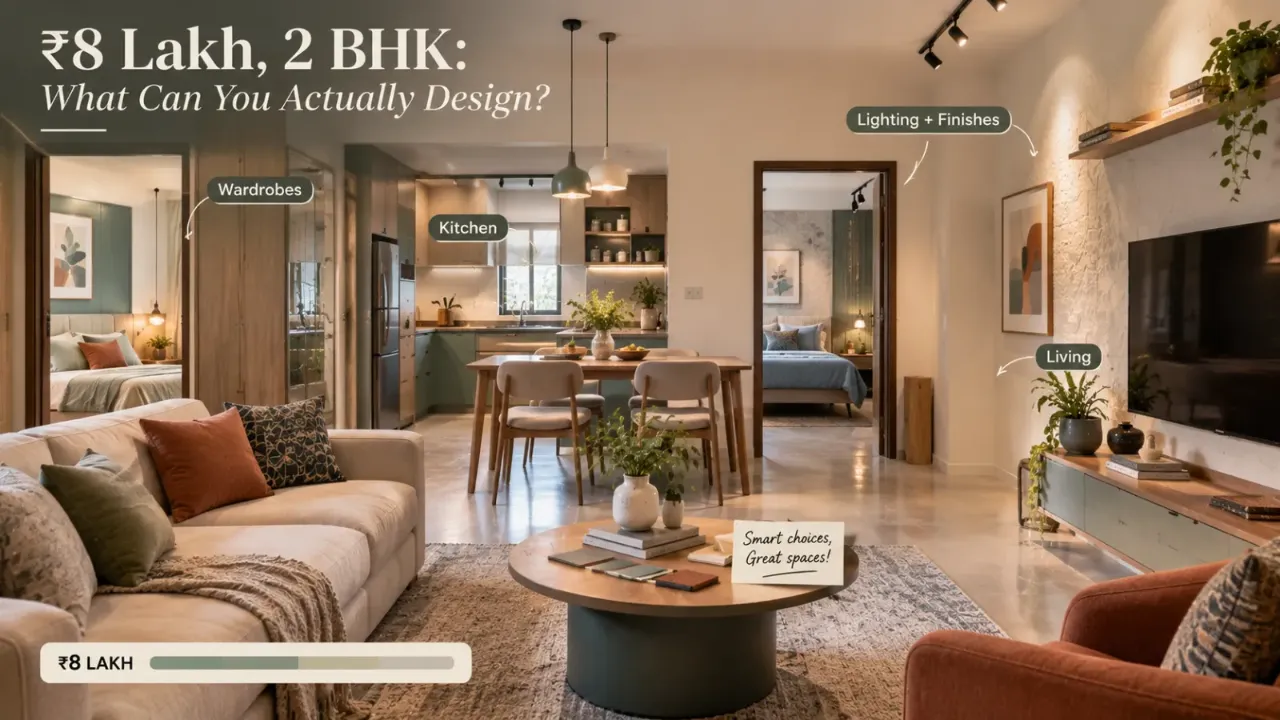
₹8 Lakh, 2 BHK: What Can You Actually Design?
₹8 lakh sounds like a clear number. But in interior design, a clear number does not automatically mean a clear scope. One homeowner may use ₹8 lakh to create a kitchen, two wardrobes and a simple living room. Another may expect a full false ceiling, premium finishes, custom furniture, designer lighting, feature walls, curtains, décor and completely renovated bathrooms.
Both may call it an “₹8 lakh interior.” That is where the confusion begins.
The real question is not whether a 2 BHK can be designed for ₹8 lakh.
First: ₹8 Lakh Is a Scope, Not a Style
A budget does not decide whether your home will look modern, warm, minimal or contemporary. Your scope does.
You can create a very attractive home within ₹8 lakh, but it may not include every feature you see in premium interior projects.
That means making a few decisions early: Do you need both bedrooms fully customised? Do you need a complete ceiling treatment? Do you need new flooring? Do you want all furniture made by the same carpenter? Do you need a bathroom renovation? Do you want high-end finishes everywhere? Do you need decorative panelling in every room?
Every “yes” takes money away from something else.
So the first rule is simple: Do not budget room by room. Budget by priority.
What Should Get the Money First?
In most homes, some elements are much harder to compromise on than others.
The kitchen is one. Wardrobes are another. Daily-use furniture, practical storage, lighting and basic electrical work also deserve attention.
Décor comes later.
Must Work
Kitchen, essential wardrobes, electrical requirements, basic lighting and functional storage.
Should Feel Good
Sofa, TV unit, bed, study area, dining solution, curtains and selected wall treatments.
Can Wait
Luxury décor, extensive panelling, premium accessories, elaborate ceilings and decorative upgrades.
The Principle
The goal is not to make everything luxurious. It is to make the essentials work exceptionally well.
A Practical ₹8 Lakh Allocation
There is no universal price list for every 2 BHK. Flat size, city, material choice, labour, existing finishes and the number of customised elements can change the final number considerably.
So rather than treating the following as a quotation, use it as a planning model.
| Area | Planning Allocation |
|---|---|
| Modular kitchen | ₹1.60 lakh |
| Two essential wardrobes | ₹1.80 lakh |
| Living room + TV unit + basic dining | ₹1.20 lakh |
| Lighting + limited ceiling work | ₹60,000 |
| Painting and basic wall finish | ₹50,000 |
| Entryway / utility / small storage | ₹40,000 |
| Electrical and minor civil work | ₹60,000 |
| Curtains / essential soft furnishings | ₹30,000 |
| Contingency | ₹1.00 lakh |
| Total | ₹8.00 lakh |
The exact allocation can move around. For example, a family that already owns a sofa and beds can move that money into storage or better kitchen hardware.
Someone with a builder-provided kitchen may instead spend more on wardrobes and furniture.
The important part is leaving room for unexpected costs rather than assigning every rupee to visible design.
What Fits Comfortably
A Functional Modular Kitchen
A straightforward modular kitchen with practical storage, sensible internal organisation and durable finishes can form the backbone of the budget.
The focus should be on:
- Enough drawers and cabinets for your cooking habits
- Practical corner storage
- Space for frequently used appliances
- Easy-to-clean surfaces
- Reliable hardware
- Efficient use of the available wall area
You do not need the most expensive finish to make a kitchen feel considered.
In fact, planning the kitchen around how you cook is often more valuable than upgrading the appearance of every cabinet.
Two Essential Wardrobes
Two bedrooms usually mean two wardrobes, and wardrobes can consume a large portion of an interior budget.
At ₹8 lakh, the smarter approach is to prioritise capacity and layout.
Use internal divisions based on what you actually own. Folded clothes need different storage from long garments. Accessories need different storage from luggage.
A wardrobe designed around your real belongings can feel more premium than one with an expensive exterior and poorly planned internals.
A Complete Enough Living Room
The living room does not have to become a showcase of custom carpentry.
A comfortable sofa, practical TV unit, coffee table, curtains and appropriate lighting can create a complete room without turning every wall into a feature.
One strong focal wall is often enough. The rest can stay quieter.
Basic Dining, Not a Restaurant
If your layout includes dining space, focus on getting the table and seating right for the number of people who actually use it.
A large custom dining setup with a crockery wall, decorative storage and elaborate lighting may consume money that the rest of the home needs more.
A simpler dining solution can still look intentional.
Practical Lighting
You do not need a highly layered lighting scheme in every room.
Prioritise the places where lighting genuinely changes how the home works.
General room lighting comes first. Then add focused lighting for tasks such as kitchen work, reading, studying or getting ready.
Decorative lighting can be selective. A few well-chosen fixtures usually do more than filling the ceiling with lights.
Where You May Need to Compromise
Full-Home False Ceiling
A complete false ceiling across every room can consume a meaningful part of the budget.
At this budget, it is often smarter to use ceiling work selectively. Perhaps the living room gets the main treatment while the bedrooms use simpler lighting and an existing ceiling.
The point is not to make every ceiling decorative. It is to make the lighting work.
Extensive Wall Panelling
One feature wall can be effective. Four or five fully panelled walls are harder to justify.
Fluted panels, stone-look treatments, timber details, moulding and textured finishes can all add up quickly.
Choose one or two moments that genuinely improve the home. Do not make every empty wall a project.
Premium Finishes Everywhere
A luxury laminate, veneer, glass, metallic detailing or elaborate hardware package can sound attractive when discussing individual elements.
The problem appears when you multiply that upgrade across the entire home.
At ₹8 lakh, consistency is usually more useful than trying to make every surface premium.
What Usually Does Not Fit Well
Some expectations are particularly difficult to combine with an ₹8 lakh ceiling.
A fully customised 2 BHK with premium kitchen finishes, two high-end wardrobes, designer furniture, complete false ceilings, extensive wall panelling, new flooring, renovated bathrooms, premium lighting and extensive décor is likely to require a larger budget.
That does not mean you cannot have any of those things. It means they should not all be treated as must-haves.
The Hidden Budget Killers
Visible furniture gets attention because it is easy to imagine. But several less glamorous items can quietly increase the cost.
- Electrical modifications
- Additional sockets
- Plumbing changes
- Civil repairs
- Hardware upgrades
- Delivery
- Installation
- Site-related work
- Minor changes requested after execution begins
And, of course, the classic: “Since we're already doing this, let's add one more thing.”
Keep a contingency. It may be the least exciting line in the budget, but it is one of the most useful.
Existing Flooring Can Be Your Advantage
One of the easiest ways to protect an ₹8 lakh budget is to avoid changing elements that are already acceptable.
If the existing flooring is in good condition, ask whether it really needs to be replaced.
If the bathrooms are functional and the finishes are acceptable, a complete renovation may not be the best use of money.
If the apartment already has suitable electrical points, doors or basic fittings, do not replace them simply because they are not new.
Good design does not mean replacing everything. It means identifying what is actually holding the home back.
Customise Where It Matters
Not every piece of furniture needs to be made specially for your home.
Customisation makes the most sense where it solves a specific space problem.
- A wardrobe fitting an awkward corner
- A storage unit using an otherwise dead wall
- A study desk designed around a particular window
- A kitchen adapted to the way your family cooks
These are valuable customisations.
A custom decorative table that could have been purchased ready-made is a different conversation.
At ₹8 lakh, customisation should be purposeful.
Spend on Daily Contact Points
Ask yourself: What will I touch every day?
Kitchen shutters. Wardrobe doors. Drawer channels. Cabinet handles. Switches. Work surfaces. Sofa. Bed. Desk.
These elements deserve attention because you interact with them constantly.
You may not remember the exact finish of a decorative wall six months later. You will notice a badly organised kitchen drawer every single morning.
What About Décor?
Decorative pieces should not disappear completely from a budget-conscious home. But they can come later.
Artwork, cushions, plants, rugs, mirrors and accessories can be added progressively.
This has another advantage: you get to live in the home before deciding what it actually needs.
A room often tells you what is missing after you have used it for a while.
Perhaps the empty corner needs a chair. Perhaps the wall does not need anything. Perhaps the dining area needs a mirror. Perhaps the bedroom needs softer lighting instead of another decorative panel.
Give the home some time to answer.
Three Ways an ₹8 Lakh Budget Can Go Wrong
Trying to Copy a ₹20 Lakh Home
An inspiration image may look simple, but behind it could be premium hardware, extensive carpentry, custom furniture, multiple layers of lighting or imported finishes.
Spending Too Much on One Room
A dramatic living room can look impressive in photographs, but if it consumes half the budget, the other rooms begin to look unfinished.
Leaving No Buffer
If every rupee is committed before work begins, even a small change can become a problem. A practical project needs breathing room.
Comparing Only the Total
Two quotations can have the same final number and completely different contents. Compare the scope, materials, hardware, installation and exclusions.
What an ₹8 Lakh Home Can Look Like
The most realistic version of an ₹8 lakh 2 BHK is not “budget-looking.” It is selective.
The kitchen is efficient. The wardrobes are functional. The living room is comfortable. The bedrooms have enough storage. Lighting is thoughtfully placed. The walls are not overloaded with decoration. The finishes are coordinated.
Some furniture is ready-made. Some elements are customised. And not every room is trying to look luxurious.
That is not a compromise in design quality. It is a design strategy.
The Right Question Is Not “Can I Do Everything?”
It is tempting to start an interior project by making a giant wish list.
False ceiling. Feature walls. Designer lights. Large TV unit. Full-height wardrobes. Premium kitchen. Bar unit. Crockery unit. Study. Pooja unit. Custom bed. Custom sofa.
Instead, make two lists.
Kitchen, essential wardrobes, functional furniture, storage, electrical requirements, lighting and other everyday necessities.
What would be nice to add later?
Decorative panelling, additional furniture, artwork, upgraded lighting, accessories and other non-essential enhancements.
That simple separation can completely change how ₹8 lakh performs.
Before You Finalise the Budget, Ask for Scope
Two quotations can have the same final number and completely different contents.
One may include wardrobes but exclude internal accessories. Another may include painting but not electrical modifications. One may include a basic kitchen but exclude appliances. Another may include furniture but not curtains.
So do not compare only the total. Compare the scope.
- Ask what materials are included.
- Ask what hardware is included.
- Ask what installation covers.
- Ask what civil and electrical work is included.
- Ask what is excluded.
- Ask whether taxes, delivery, installation and site-related charges are already accounted for.
The cheaper quote is not necessarily the cheaper project.
So, What Fits Under ₹8 Lakh?
A practical 2 BHK under ₹8 lakh can absolutely feel complete.
You can prioritise a functional kitchen, two essential wardrobes, comfortable living-room furniture, basic dining, useful storage, sensible lighting, painting and selected custom work.
What becomes difficult is combining all of that with a premium-everywhere specification.
The secret is not finding a magical low-cost material. It is knowing where to spend, where to simplify and what can wait.
Because a successful ₹8 lakh interior is not the one that tries to look like a ₹20 lakh home.
It is the one that makes ₹8 lakh work intelligently.
Final Thought
A budget becomes useful only when it changes the way you make design decisions.
Spend on what you use every day. Simplify what adds mostly visual drama. Keep existing elements that still work. Leave room for surprises.
And most importantly, decide the scope before the finishes start choosing the budget for you.
A well-planned 2 BHK does not need everything. It needs the right things.
Ready to Plan Your 2 BHK?
Before finalising your furniture, finishes and layout, you can use Walls to Wonder's Design My Room tool to visualise ideas around your actual space.
When you are ready for professional guidance, the Walls to Wonder designer directory can also help you explore interior designers and compare possibilities for your home.
Frequently Asked Questions
1. Can a 2 BHK be fully designed under ₹8 lakh?
Yes, a focused and practical scope can fit within ₹8 lakh. The result depends on the flat size, location, existing finishes, material choices and how much customised work is included.
2. What should I prioritise in an ₹8 lakh 2 BHK interior?
Start with the kitchen, essential wardrobes, functional furniture, storage, electrical requirements, lighting and painting. Decorative upgrades can be added selectively or later.
3. Can I include false ceilings in an ₹8 lakh budget?
Yes, but full-home false ceilings may put pressure on the budget. Selective ceiling work in key spaces is usually easier to accommodate.
4. Can premium laminates and finishes fit into the budget?
Some premium finishes can fit when used selectively. Using premium materials across the entire home can quickly reduce the amount available for other essentials.
5. Should appliances be included in the ₹8 lakh interior budget?
Decide this before finalising the budget. Appliances can significantly change the available amount for interiors, so they should be treated as a separate line item or clearly included in the scope.
6. Is custom furniture necessary for a budget 2 BHK?
No. Customise where the furniture needs to solve a specific space or storage problem. Ready-made furniture can often be a better choice for less specialised requirements.
7. How much contingency should I keep?
A contingency is useful because electrical changes, civil work, hardware upgrades and other unexpected requirements can appear during execution. The exact amount depends on the condition and scope of the home.
Get a personalised estimate for your home
Choose your rooms, materials and preferences to understand a practical interior budget before you commit.