
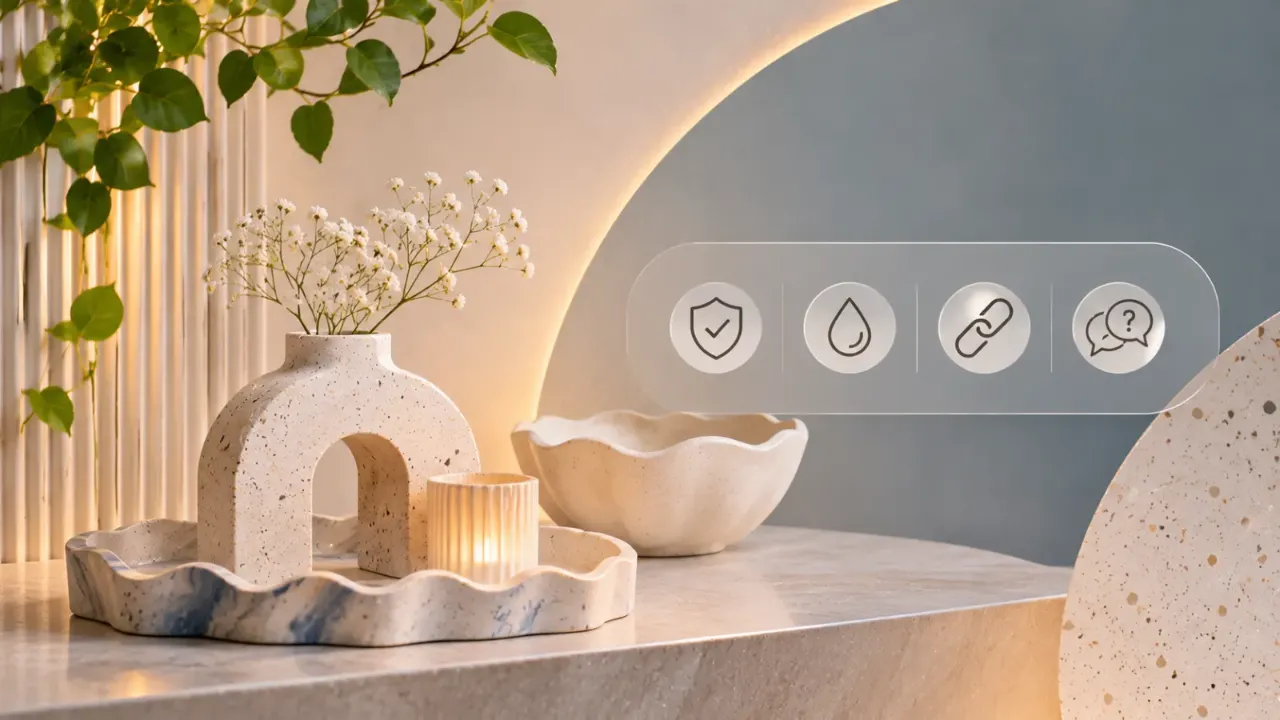
Is Jesmonite Safe, Durable and Water-Resistant? A Homeowner's FAQ
Jesmonite has become a popular choice for contemporary home décor. From terrazzo-effect trays and planters to candle holders, decorative panels and furniture accents, it offers a stone-like appearance with considerable freedom in colour, texture and shape. Its handcrafted finish also makes it appealing to homeowners looking for something different from mass-produced accessories.
But appearance alone is not enough when choosing a material for the home. Will it withstand everyday handling? Can it be placed in a bathroom? Is it safe around food? Does it stain easily, and how much maintenance does it require?
The answers depend on the particular Jesmonite formulation, the way the item has been manufactured and, importantly, whether its surface has been sealed. Here are the questions homeowners should consider before purchasing Jesmonite products.
1. What Exactly Is Jesmonite?
Jesmonite is a family of composite materials generally made by combining a mineral base with a water-based acrylic resin. It can be cast into moulds or used in decorative and architectural applications.
Different formulations serve different purposes. For example, AC100 is an acrylic-modified gypsum composite, while AC730 is an acrylic-modified cementitious composite. They should not be treated as interchangeable products.
Jesmonite is used for:
- Decorative trays, bowls and coasters
- Planters and small home accessories
- Candle holders and sculptural objects
- Wall panels and decorative mouldings
- Furniture details and interior features
- Custom-made decorative surfaces
Its main attraction is its versatility. Pigments, aggregates and different moulding techniques can produce smooth, matte, terrazzo-style and stone-inspired finishes.
2. Is Jesmonite Safe for Home Use?
Generally, Jesmonite is a water-based, non-solvent material. The manufacturer describes its products as water-based and non-solvent, which makes them different from many conventional solvent-based systems.
However, this does not mean every finished Jesmonite object is automatically suitable for every household application.
- During manufacture: Mixing, sanding, polishing and applying sealers can create dust, splashes or fumes from associated products. Follow the product's safety data sheet and use suitable gloves, eye protection, dust protection and ventilation.
- After curing: A fully cured decorative object is different from the uncured mixture. Still, the suitability of the finished item depends on its formulation, finish and intended use.
- For children and pets: Avoid assuming that an object is suitable for chewing, food contact or rough handling simply because its base material is water-based. Check the product's intended use and keep small, breakable accessories out of reach where necessary.
For normal decorative use, Jesmonite can be a practical material. For applications involving direct food contact, prolonged water exposure or high temperatures, additional checks are necessary.
3. Is Jesmonite Waterproof?
No. Jesmonite should not automatically be considered waterproof.
The manufacturer's guidance states that Jesmonite materials, including AC100, are porous. A suitable topcoat sealer is needed to create a water-resistant or waterproof surface.
This distinction matters because an unsealed object may absorb moisture. Depending on the formulation and conditions, repeated exposure can contribute to staining, surface marks or deterioration.
A sealed surface performs better, but the result depends on the sealer, the number of coats, application quality and maintenance.
For example:
- A decorative tray used for dry accessories may need relatively modest protection.
- A bathroom accessory exposed to splashes needs an appropriate water-resistant finish.
- A planter holding soil and water needs a suitable internal barrier or liner.
- A surface exposed to standing water or continuous moisture needs a product specifically approved for that application.
Do not assume that a glossy finish means an object is waterproof. Ask the seller what sealer has been used and what level of water exposure the finished product can handle.
4. Can Jesmonite Be Used in Bathrooms and Kitchens?
It can be used selectively, but the exact formulation and finishing system matter.
Jesmonite's manufacturer identifies AC730 as a suitable option for decorative kitchen and bathroom splashbacks. That does not mean every Jesmonite product is appropriate for every wet-area application.
In bathrooms, consider using it for decorative accessories, wall features or splash-prone areas only when the product and finish are suitable. Avoid installing an ordinary decorative casting where it will remain wet or be exposed to continuous water.
In kitchens, decorative trays, wall accents and selected splashback applications may be possible. However, the surface must be appropriate for the expected exposure and cleaning routine.
Before specifying Jesmonite in either space, confirm:
- The exact Jesmonite formulation
- Whether the product is intended for the location
- The type of sealer and its maintenance requirements
- Whether joints, edges and fixing points are protected
- Whether the manufacturer or fabricator provides application-specific guidance
For a shower enclosure, sink basin or continuously wet surface, do not rely on a decorative sealer alone. Ask for a tested system designed for that level of exposure.
5. How Durable Is Jesmonite?
Jesmonite can be durable when correctly mixed, cured, manufactured and used for its intended purpose.
The AC100 technical information describes good abrasion resistance and impact strength, along with high compressive and tensile strength. These properties make it suitable for many decorative castings and interior features.
However, durability is not the same as being indestructible.
A Jesmonite tray can still chip if dropped. Thin edges and delicate decorative details may be more vulnerable to impact than thicker, well-supported pieces. Surface scratches and stains can also occur depending on the finish and how the item is used.
For everyday home use:
- Choose thicker, well-finished products for frequently handled accessories.
- Avoid dropping or striking pieces against hard surfaces.
- Use protective pads beneath objects placed on delicate furniture.
- Keep heavy items away from unsupported edges.
- Follow the manufacturer's cleaning and maintenance instructions.
For architectural panels or larger installations, the design, reinforcement, fixing method and substrate are just as important as the material itself.
6. Does Jesmonite Scratch, Chip or Crack Easily?
It can scratch, chip or crack under unsuitable conditions, but the risk depends on the product's thickness, construction, finish and use.
A small decorative accessory may withstand ordinary handling but still be damaged if dropped onto a hard tile floor. Sharp impacts can be particularly problematic around thin corners and edges.
To reduce damage:
- Avoid stacking heavy objects on delicate pieces.
- Do not drag accessories across rough surfaces.
- Use coasters or protective pads where appropriate.
- Handle thin or sculptural items carefully during cleaning.
- Inspect larger panels and installations for damage around joints and fixing points.
If a piece develops a chip or crack, ask the manufacturer or fabricator whether it can be repaired. A surface repair may improve appearance, but it does not necessarily restore the original strength or water resistance.
7. Is Jesmonite Heat-Resistant?
Do not assume that Jesmonite is heatproof.
Its suitability for heat exposure depends on the formulation, the thickness of the object, the sealer and the conditions in which it is used. Sealers also have their own temperature limitations.
For example, a decorative candle holder may be designed to hold a candle, but that does not establish that every Jesmonite holder is safe for direct flame, hot wax or prolonged heat.
A few sensible precautions:
- Do not place hot cookware directly on Jesmonite surfaces unless the manufacturer explicitly approves it.
- Use heat-resistant mats beneath hot vessels.
- Keep finished objects away from direct flames.
- Check the product's intended use before buying candle accessories.
- Do not assume that a fire classification for a material makes a finished household object fireproof.
The manufacturer also states that its sealers are not fireproof and that it has not established a generally suitable burn-proof sealer. For heat-related applications, ask for specific product guidance rather than relying on appearance or general claims.
8. Is Jesmonite Food-Safe?
This is an important point for anyone considering Jesmonite bowls, plates, trays or serving accessories.
The manufacturer states that its Jesmonite materials have not been tested for food safety. It does not recommend placing food or liquids directly onto finished Jesmonite products.
That means a decorative bowl should not automatically be treated as a serving bowl, and a sealed tray should not automatically be assumed to be safe for direct food contact.
Safer uses include:
- Displaying wrapped food without direct contact, where the product's intended use allows it
- Holding keys, jewellery or other small accessories
- Displaying decorative objects
- Using trays for dry, non-food items
For serving food, choose products specifically tested and approved for food contact. A seller's claim that a piece is sealed or non-toxic is not a substitute for food-safety testing.
9. Does Jesmonite Stain Easily?
Jesmonite can stain, particularly when its surface is porous or inadequately sealed.
Common household substances such as coffee, tea, oils, cosmetics and coloured liquids can leave marks if they are allowed to sit on the surface.
A suitable sealer helps reduce absorption, but it does not make every surface immune to staining.
For better protection:
- Wipe spills promptly.
- Use a soft, damp cloth for routine cleaning.
- Avoid leaving oily or strongly coloured substances on the surface.
- Test cleaning products on an inconspicuous area.
- Follow the sealer manufacturer's instructions.
The level of protection varies, so ask the seller whether the finish is intended to resist water, oil, stains or only light everyday contact.
10. How Do You Clean and Maintain Jesmonite?
Jesmonite is generally straightforward to maintain when used in suitable conditions.
For routine care:
- Remove dust with a soft, dry or slightly damp cloth.
- Wipe ordinary marks gently rather than scrubbing aggressively.
- Avoid abrasive scrubbers and harsh cleaning chemicals unless approved.
- Do not leave standing water on the surface.
- Dry the object after cleaning, particularly around joints and edges.
- Follow the recommended reapplication schedule for the specific sealer.
The manufacturer's sealer guidance notes that acrylic and gloss coatings may need recoating approximately every six to ten years. This is not a universal schedule for every finish or application; actual maintenance depends on exposure, wear and the product used.
If an object is placed in a frequently used area, inspect its surface periodically. Peeling, dull patches, persistent water marks or changes in surface feel may indicate that the finish needs attention.
11. Is Jesmonite Suitable for Outdoor Use?
Some Jesmonite formulations are designed for exterior applications when appropriately sealed, while others are intended primarily for interiors.
This is why checking the formulation is essential.
For instance, current manufacturer product information distinguishes between formulations intended for interior applications and those that can be used externally once appropriately sealed. AC100's technical information recommends a suitable sealer or paint system for external use to protect its surface appearance.
For an outdoor installation, consider:
- Rain and prolonged moisture exposure
- Direct sunlight and temperature changes
- Freeze-thaw conditions where relevant
- The quality of the sealer or paint system
- Drainage and the way the object is supported
A small decorative object on a covered balcony has different requirements from a planter left in an exposed garden. Confirm that the complete finished product is suitable for the actual conditions.
12. What Should Homeowners Check Before Buying Jesmonite Products?
Before purchasing a Jesmonite accessory or specifying it in an interior project, ask the seller or fabricator a few practical questions.
| What to check | Why it matters |
|---|---|
| Exact formulation | Different Jesmonite products have different properties and applications |
| Sealer used | Determines the surface's protection and maintenance needs |
| Water exposure | Helps establish whether the product suits the intended location |
| Food-contact testing | Important for bowls, plates and serving accessories |
| Heat limitations | Prevents unsuitable use near flames or hot cookware |
| Thickness and construction | Affects impact resistance and handling |
| Repair options | Helps if the item chips, cracks or gets damaged |
| Care instructions | Clarifies cleaning and recoating requirements |
For larger architectural features, also ask about reinforcement, installation details, substrate preparation, joints and warranty coverage.
13. Is Jesmonite Worth Choosing for Your Home?
Jesmonite is worth considering when you want a distinctive decorative finish, custom colours, interesting textures or handcrafted home accessories. It can work particularly well for trays, decorative objects, selected wall features and furniture details.
However, it is not a universal replacement for ceramic, glass, stone or other materials. Its limitations around water exposure, food safety and heat should influence where you use it.
A simple way to decide:
- For decorative accessories: A good option when properly finished and handled.
- For trays and organisers: Suitable for non-food uses, subject to the sealer and care instructions.
- For bathrooms: Consider only products and finishes appropriate to the expected moisture exposure.
- For kitchens: Check the formulation and application before using it as a splashback or surface feature.
- For food serving: Do not assume it is food-safe; the manufacturer has not tested its products for food safety.
- For outdoor use: Select a formulation and protective system specifically suitable for exterior conditions.
Closing Thoughts
Jesmonite combines design flexibility with useful strength, making it an appealing material for modern home interiors. But its performance depends on more than its appearance. The formulation, curing, surface sealer, installation and everyday care all influence how well it performs.
For homeowners, the most important rule is simple: choose Jesmonite for the application it is designed for, and do not confuse water-based with waterproof, sealed with food-safe, or durable with indestructible.
A little checking before purchase can help you enjoy its finish without unpleasant surprises later.
Explore More with Walls to Wonder
Planning your next home upgrade? Explore Walls to Wonder's AI-powered tools to visualise spaces, understand costs and make more informed interior design decisions.
- Whole Home Visualizer
- Design My Room
- Interior Design Cost Estimate
- Interior Quotation Checker
- Rate My Room Design
- Interior Style Finder
Discover more ideas and tools at Walls to Wonder.
Turn this idea into a plan for your home
Visualise your space, understand the likely budget, or find a professional who can bring the idea to life.